The $123 Billion Turning Point: SpaceX Unlocks August 6
The most telegraphed supply event of the year hits today. Here’s the flow math, the levels, and the playbook.
911 million shares become sellable today, 1.4x the entire existing float. Everyone sold ahead of it, 34% of the float is short, and four index inclusions sit underneath as price-insensitive buyers. Telegraphed supply into a stock already down 50% is not the same trade as surprise supply.
The mechanics: what actually unlocks, and when
Eight weeks ago, SpaceX pulled off the largest IPO in history: $135 a share, a $1.8 trillion valuation, and a float so thin it was almost decorative. Just 639 million shares, less than 5% of the company. Scarcity did what scarcity does. The stock ran to $225.64 within days.
Then the calendar started working against it. Today, roughly 911.5 million shares, worth about $100–123 billion, become sellable for the first time. That’s not a supply increase. That’s 1.4x the entire existing float hitting eligibility in a single session, held by early employees and pre-IPO investors who are sitting on life-changing paper gains and just watched the stock get cut in half.
Most traders will read that setup as obviously bearish. That may be exactly why it isn’t. Here’s the walkthrough.
This isn’t a single cliff. It’s a staircase.
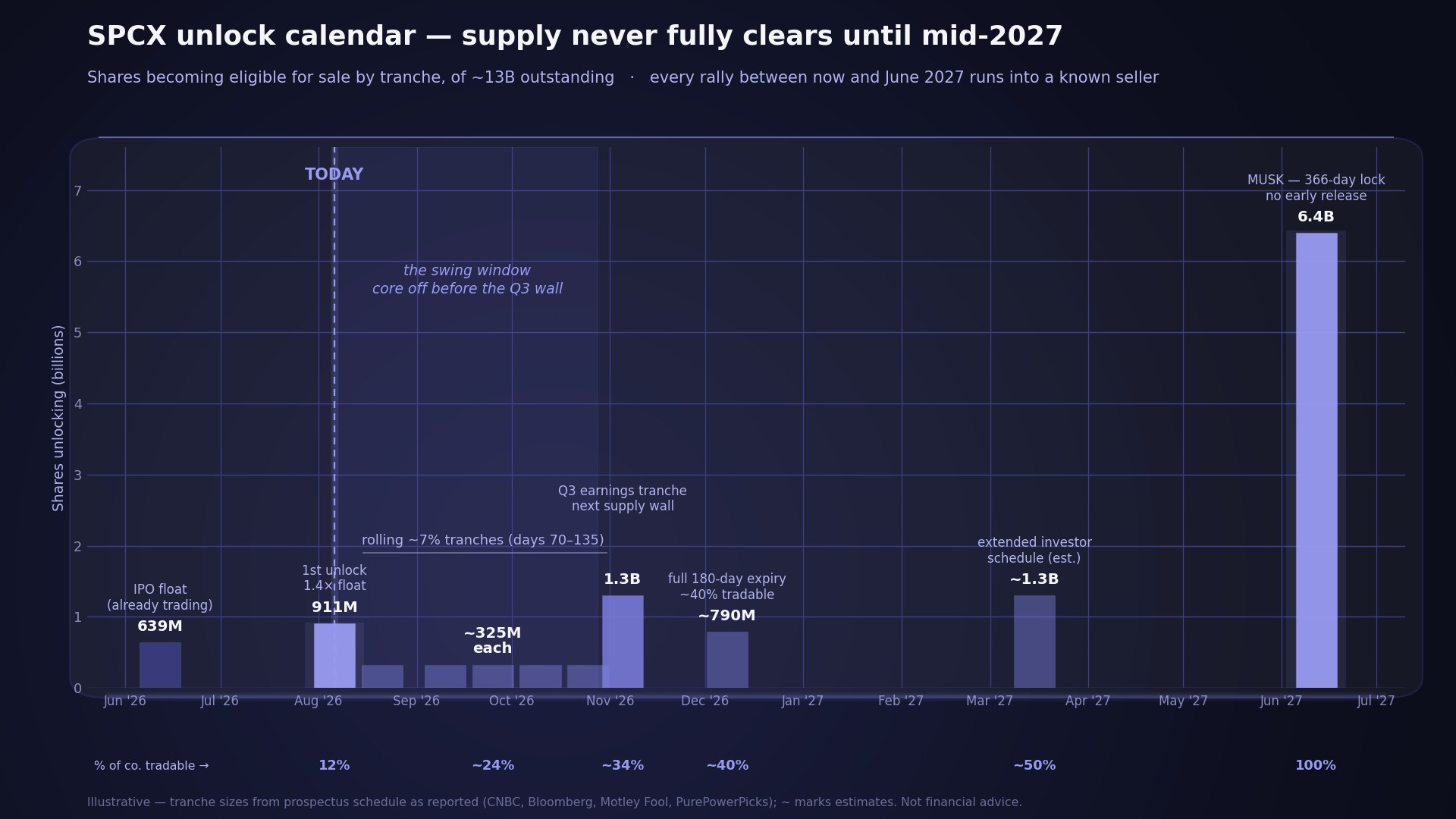
Today’s tranche was triggered automatically by the Q2 earnings release on August 3. From here, rolling tranches of roughly 7% release at the 70/90/105/120/135-day marks through October. The Q3 earnings release unlocks the biggest 2026 block, about 1.3 billion shares, in late October or November. The standard 180-day lockup fully expires December 8, putting roughly 40% of the company in tradable hands. And Elon Musk’s ~6.4 billion Class A shares, the largest single block by far, stay locked until June 12, 2027, with no early-release provisions.
The design matters. A staggered schedule prevents one catastrophic flush, but it also means every rally between now and mid-2027 runs into a known seller. That’s the regime. Trade accordingly.
The tape into the event
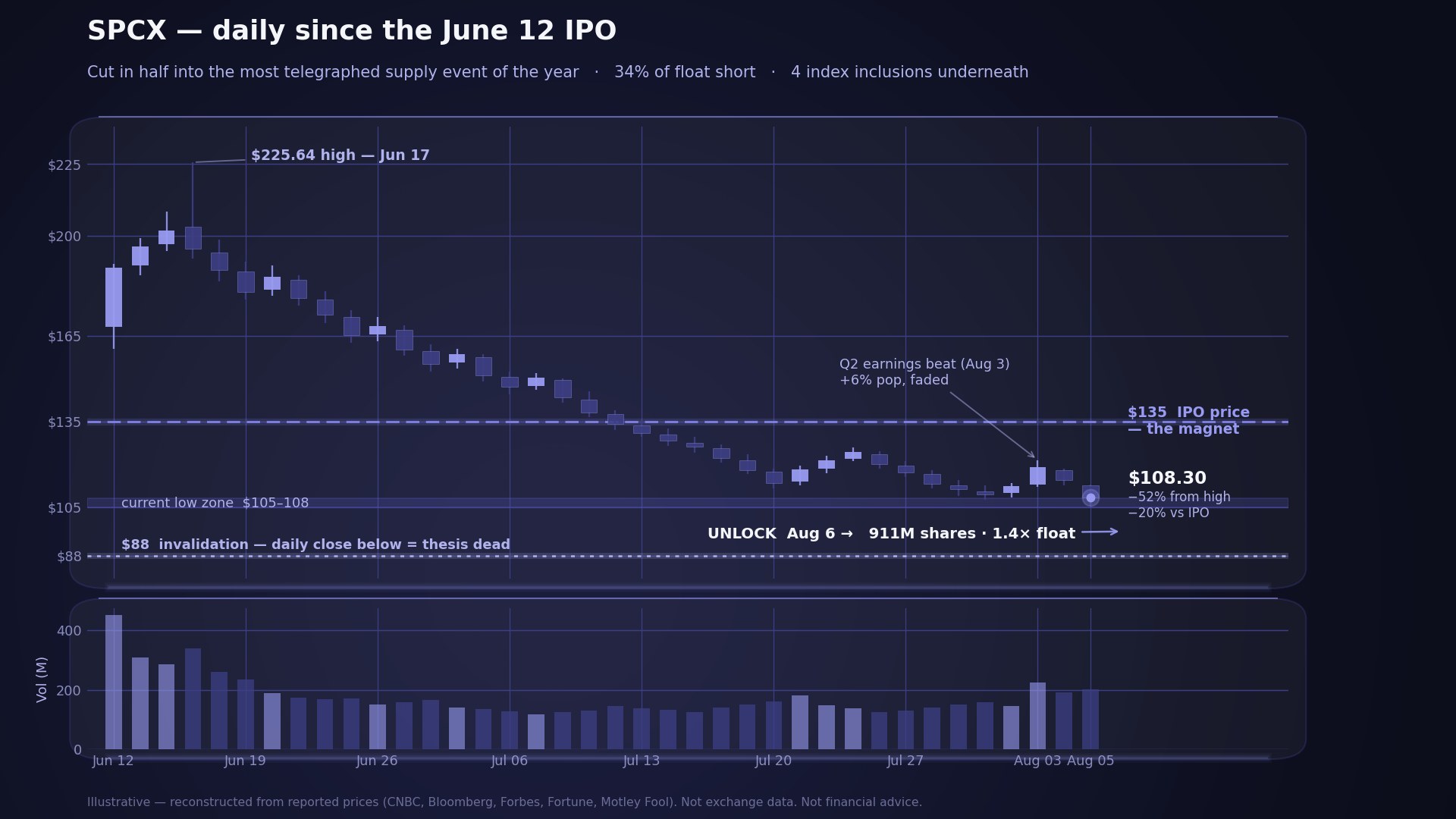
The stock closed Wednesday around $108, down ~50% from the June high and ~20% below the IPO price, after bleeding 9–13% in the final sessions before the unlock. Volume has expanded to 200M+ shares a day against a 639M float. This is pre-event de-risking, and it’s been violent.
Here’s what makes it interesting rather than just ugly: the selling happened into strong fundamentals. Q2 earnings, reported August 3, beat on essentially every line. Revenue of $7.8 billion, up 92% year over year against a ~$6.8B consensus; net loss narrowed to $541 million versus roughly $1.9 billion expected; Starlink at $4.3 billion, up 66%; adjusted EBITDA of $3.5 billion, nearly double estimates. The stock popped 6% on the print and gave it all back within hours.
When a stock can’t rally on a clean beat, the market is telling you price is being set by flow, not fundamentals. Fine. Then analyze the flow.
The flow math: three forces colliding
Force one: the supply. 911M shares eligible today. But eligible is not the same as sold. These holders are employees and early investors, many of whom have been in for a decade-plus. D.A. Davidson’s Gil Luria made the point that diversification is “the natural course of business” and some will sell, but banks lean on large holders to stagger sales, and nobody dumps their entire position into a stock 50% off its highs if they can help it.
Force two: the shorts. As of late July, short interest stood at 219.3 million shares, roughly 34% of the float, or $24.6 billion in dollar terms. That is an extraordinary number. A third of the tradable stock is borrowed and sold, positioned for exactly the event that everyone can see on the calendar. Crowded, consensus, and fully expressed. If the unlock supply gets absorbed, even sloppily, that cohort becomes forced demand.
Force three: the passive bid. This is the piece most retail traders are missing. Four index providers (CRSP, FTSE Russell, MSCI, and Nasdaq) added SpaceX within 25 days of listing, an unusually accelerated path that Luria bluntly called “a little bit of a bailout” negotiated by SpaceX’s bankers before the IPO. JPMorgan estimates the Nasdaq inclusion alone moved $4 billion into passive accounts. Every 401(k) tracking those indexes is now a structural, price-insensitive buyer sitting underneath this unlock.
So: telegraphed supply, a stock already repriced 50% lower into the event, a heavily crowded short base, and a mandated passive bid. Historically — Facebook 2012 is the canonical case — this configuration resolves as flush, absorb, squeeze more often than clean breakdown. The panic happens before and at the event; the asymmetry lives after it.
The playbook
This is not a buy-the-open trade, and it is not a bottom-tick guess. The setup is confirmation-based; the tape will show which scenario is unfolding within a session or two.
The long trigger. A capitulation flush into the $95–105 zone on climactic volume (think 300M+ shares) that closes well off the lows. A high-volume hammer or bullish engulfing on unlock day would be the single most important candle since the IPO. Alternative entry if the flush never comes: a reclaim of the $114–118 breakdown zone on volume.
The target ladder. $135 first. It’s the IPO price, the heaviest volume node on the chart, and the 0.236 retracement of the full range. It’s a magnet. Above that, $160–165 (the 0.5 retrace and July’s breakdown shelf), and $180 (the 0.618) if the short base genuinely breaks and this turns into a squeeze.
The invalidation. A daily close below $88. Below there, the market is telling you the unlock supply overwhelmed every source of demand, the overhang thesis wins, and there is no long trade until the later tranches clear. No averaging down, no thesis-stretching. Flat, and revisit after December 8.
The clock. This is a swing trade with an expiration date. The Q3 unlock of 1.3 billion shares is the next supply wall in late October. Core position comes off before it. Every rally in this name is rented, not owned, until mid-2027.
The caveats that matter
At 47–74x sales, nothing about this trade is a valuation call. Analyst targets literally span $50 to $300, which tells you nobody has a model, they have narratives. This is a flow trade with defined risk, sized at half normal because single-name headline risk (Musk, Starship, politics) can gap this stock 10% overnight in either direction, straight through any stop.
The unlock is the test the IPO never had. For eight weeks, price discovery happened on 5% of the company. Starting today, the real owners get a vote. Watch the volume, watch the close, and let them show you their hand before you show yours.
Sources
- CNBC: SpaceX earnings date and lockup expiration mechanics
- Bloomberg: SpaceX’s $116B share release begins
- Forbes: Nearly 1 billion SpaceX shares unlock August 6, short interest and price action
- Fortune: Index inclusion mechanics and D.A. Davidson’s Gil Luria on the “bailout”
- The Motley Fool: 911.5M share unlock details and float math
- PurePowerPicks: Full SPCX lockup schedule 2026–2027
- BingX: Q2 2026 earnings breakdown and analyst price targets
This note is part of Boole’s desk research series. Not financial advice. Do your own research and size for the volatility this name actually has, not the volatility you’d like it to have.