Introducing Boole AI
Boole is the coding agent for ambitious traders. From a plain-English idea to live execution across perpetual futures and prediction markets, 24/7.
Professional trading firms rely on large teams of analysts, execution systems, risk controls, and monitoring infrastructure. Most independent traders do not have access to these tools. Boole delivers all of those functions to you with a frontier AI model that works in a trading computer dedicated to your trading account.
Boole gives traders their own AI-powered trading desk
Most trading strategies, the general forms that work, have been researched and found. They tend to be simple thoughts, a thesis that captures a strong, empirically verifiable movement. But of course, in their simplest form, they won’t be alpha. As such, these strategies must be manipulated to new venues, or new patterns, or with different tech. The strategies that you think of aren’t as valuable, then, at the end of the day; it is how you apply strategies that have worked, in new ways and with good infrastructure, that actually drives alpha discovery. Building that infrastructure is hard. It involves drawing on data, cleaning that data, using it to generate signals, having an execution algorithm, monitoring the order book for certain metrics, baking in risk control, and so on. That’s where Boole comes in.
Boole takes your trading ideas and turns them into something actionable with its infrastructure: new venues that yield more inefficiencies, alternative sources of data, and a server located closest to where your favourite exchanges are. All of these give you the traditional quant-desk tools to far outcompete other traders, at multiple times the speed.
If you can explain your strategy, you can run it.
Trading is full of repetitive work
Manual trading is really tiring. It involves constant monitoring and a really disciplined psychological mindset that takes decades to train. Typically you cannot win, and the ones who actually make money in these markets are those with the data, the algos, and the infrastructure.
Markets run 24/7 in DeFi, and you want your strategies to do the same. If trading isn’t your full-time job, you probably can’t sit in front of a chart all day monitoring your strategy and portfolio. Nor do you really want to. That’s unhealthy.
Even basic strategies like trend following, which may not be high-frequency, take a lot of emotional discipline to perform well. As core a skill as it is, that doesn’t come naturally to most people. Since you’re trading against other people, to win you need to act differently, your psychological approach has to be more machine than the FOMO most manual traders fall toward.
This responsibility is partially offloaded when you have an actual machine trade for you. Dedicated infrastructure, rule-based execution, and strict risk controls are all baked into your system. You research and decide what is optimal for your long-run performance. This was completely out of reach for even institutional traders for a long time, because setting it all up is a lot of work, at least before AI. Though LLMs have democratised code as a basic ability, that doesn’t replace the knowledge needed to build and run these systems, let alone make them reliable.
Boole gives you access to these tools. We have thought through the infrastructure, execution, risk management, and LLM integration so that you don’t have to. You would be surprised how hard it actually is to get an LLM to reason accurately about the market, and then for a system to act on that. Well, maybe not. Think of all the times ChatGPT has hallucinated on you.
Key features
Your own dedicated computer
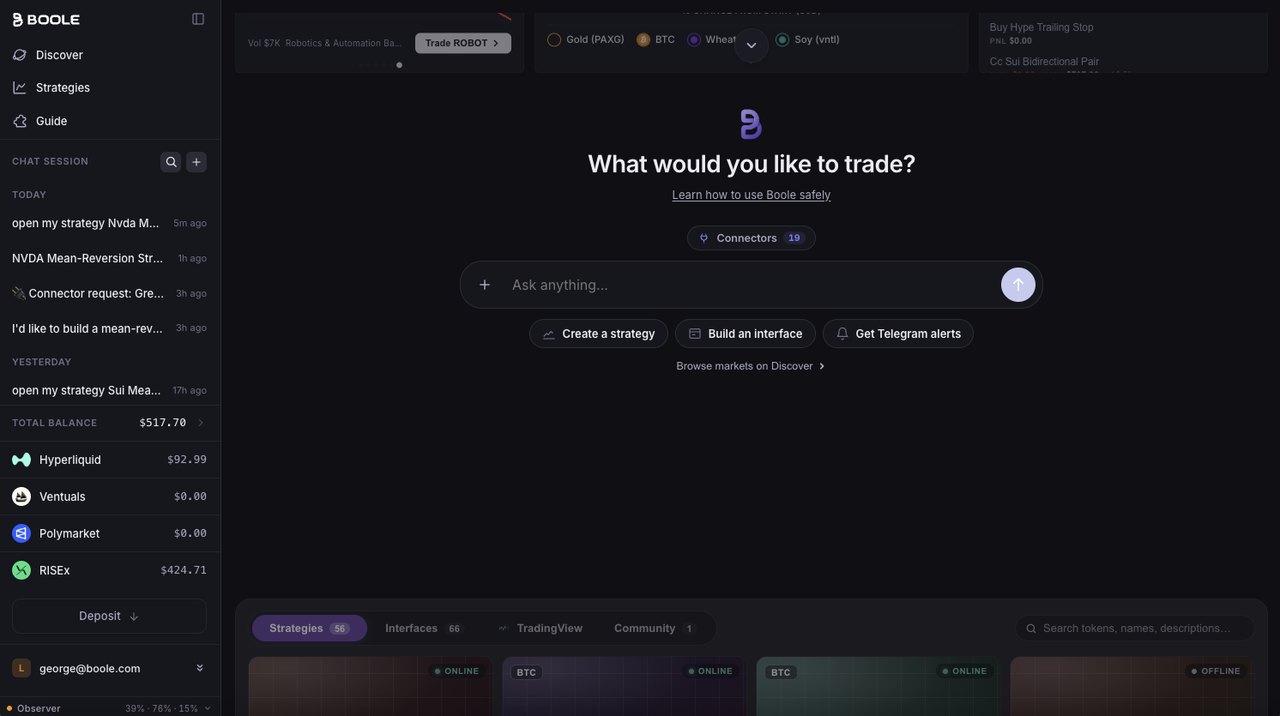
Boole doesn’t run your agent in a shared queue alongside everyone else. Every account gets its own dedicated cloud computer, an always-on environment that belongs to you and nobody else. Your agent lives there the way a person lives at a desk: it has its own memory, its own connectors, its own running strategies, and its full compute pointed at your account around the clock.
Because the machine is yours, its resources work for you 24/7. It keeps watching the market, running strategies, and reacting to events while you sleep, travel, or work your day job, there is no cold start and nothing else competing for its attention. And because it is a real environment rather than a sandbox, you can shape it however you want: install the connectors you need, keep the data sources you rely on, and let the agent build up context on how you trade over time. It is less a chatbot you poke at and more a tireless desk analyst that never logs off.
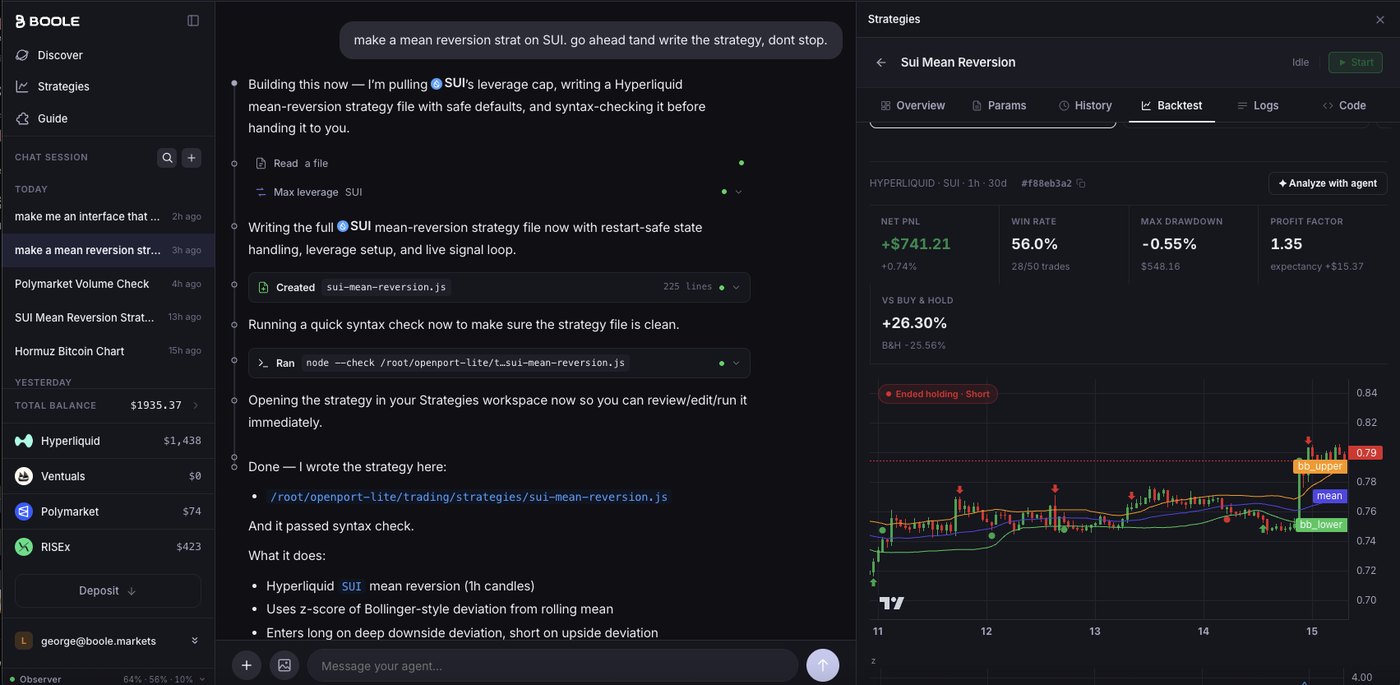
Natural language to strategy
It is likely, as a trader, that you already have an inkling of what strategies you want to run. A list of ideas you always wanted to test. But you could never build all of them into fruition. Below then are some examples of strategies you can run automatically, and immediately through a prompt, on Boole:
- Buy BTC when funding turns heavily negative and open interest starts to reset, then exit when funding returns to normal.
- Accumulate ETH weekly, but increase size after a sharp pullback.
- Trade a basket of AI tokens together instead of managing each one manually.
- Follow a high-performing Hyperliquid vault, but apply your own max drawdown and position limits.
- Buy or sell based on a real-world event, such as an election result, ETF approval, earnings release, or prediction-market outcome.
- Reduce exposure before a major token unlock, then re-enter once selling pressure cools down.
- Run a simple trend strategy, such as buying when price breaks above a moving average and exiting when momentum fades.
Or maybe you already have a TradingView strategy in mind? Just import that and run it in Boole. The edge comes from knowing what strategies to apply in which situations: different venues, assets, or ideas that few people can try at scale.
Live connectors
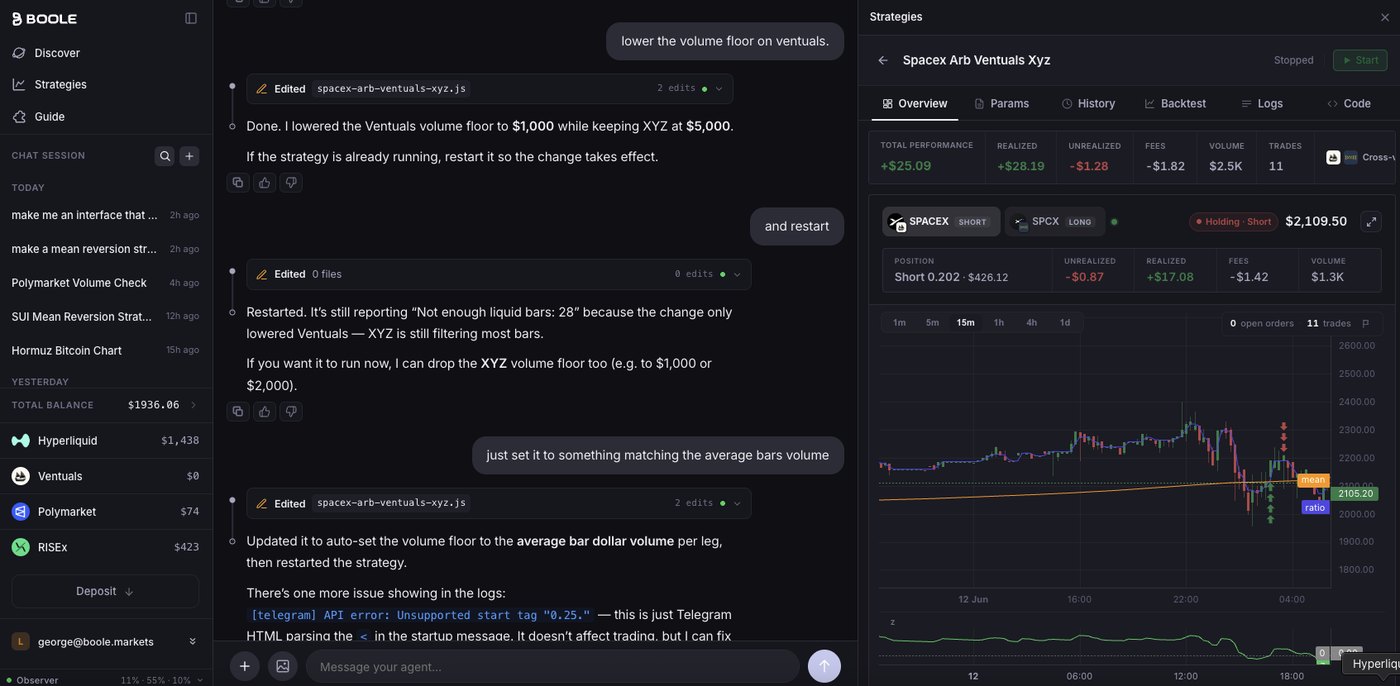
We give you a suite of venues, data sources, and workflows you can connect to in real time. Once you plug your connectors into Boole, it can access coin data from a source like CoinGecko, or fetch and parse SEC filings and then act on that information on Polymarket. You decide which tools Boole needs to run your strategy, in a few clicks. If a connector you want does not exist yet, you can request it: it is a community process, since one connector built is one connector for every user.
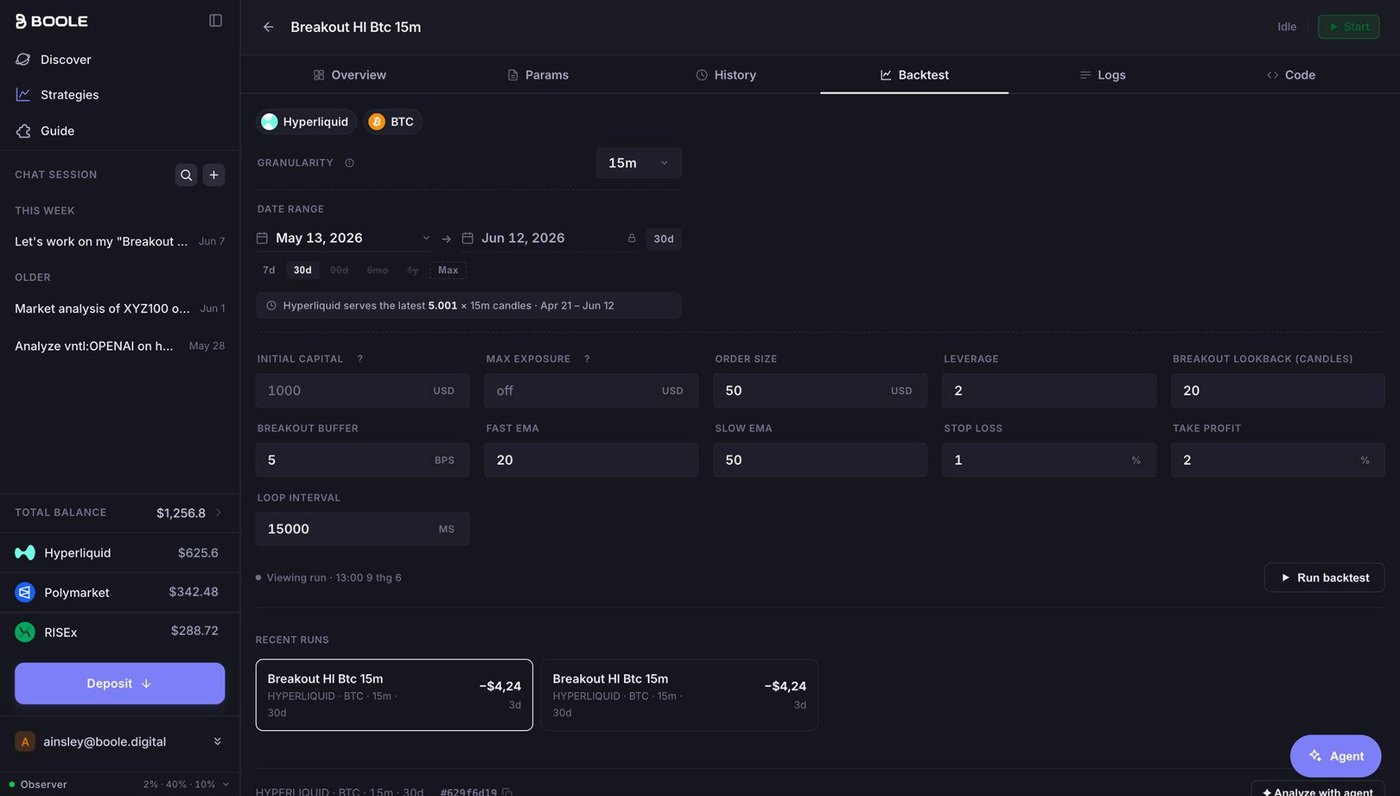
Backtesting and live execution
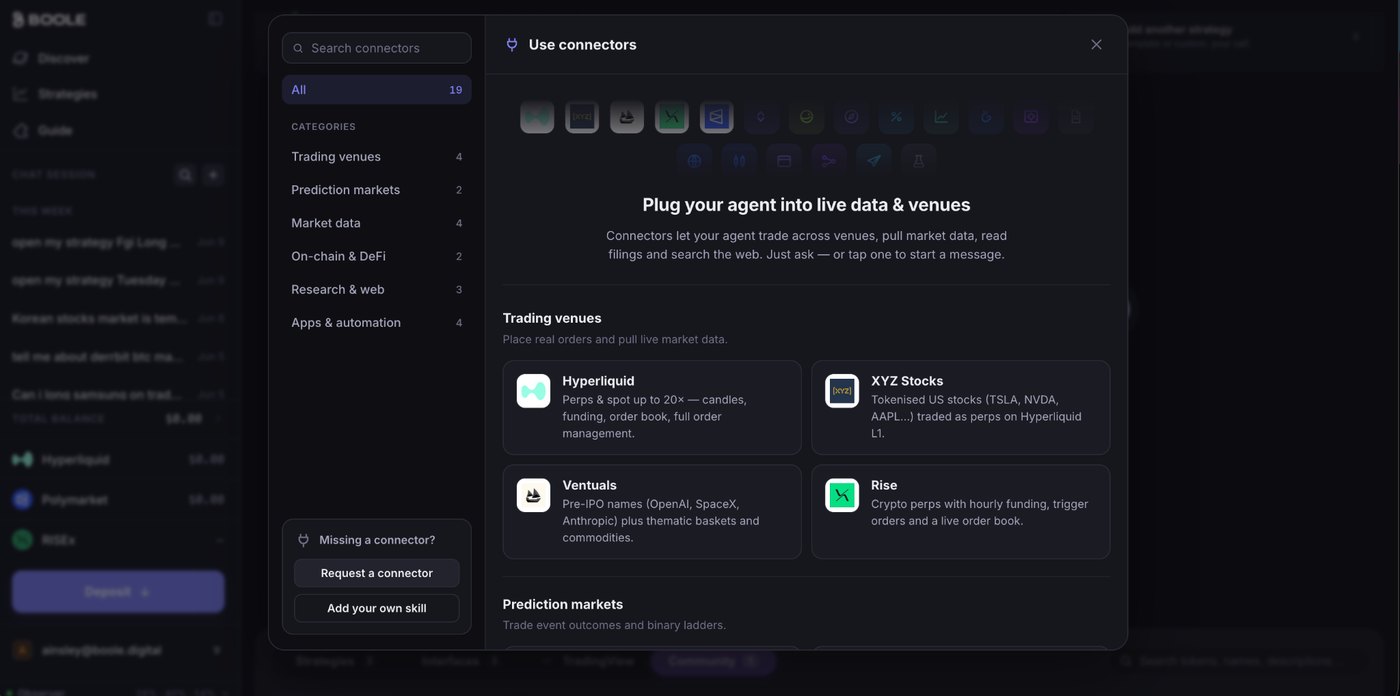
For most strategies, no backtesting is equivalent to gambling. You need some empirical basis that your strategy might indeed be profitable, so you test it against historical data to get a sense of how it would have performed. For certain strategies backtesting can be a little hard: there may be a lack of data, and in those cases it is probably best to live-test with a small amount of capital for a while.
Once live, Boole runs continuously across supported venues, including perpetual futures markets and prediction markets. For larger orders, execution can be optimised using TWAP and VWAP order slicing to reduce market impact rather than sending everything to market at once. On Polymarket, event-driven strategies can automatically enter, manage, and exit positions when predefined conditions are met.
Whatever strategy you decide to run, Boole will help you optimise it. The workflow within our platform guides you through defining your strategy, testing it, and executing on it.
Risk and control
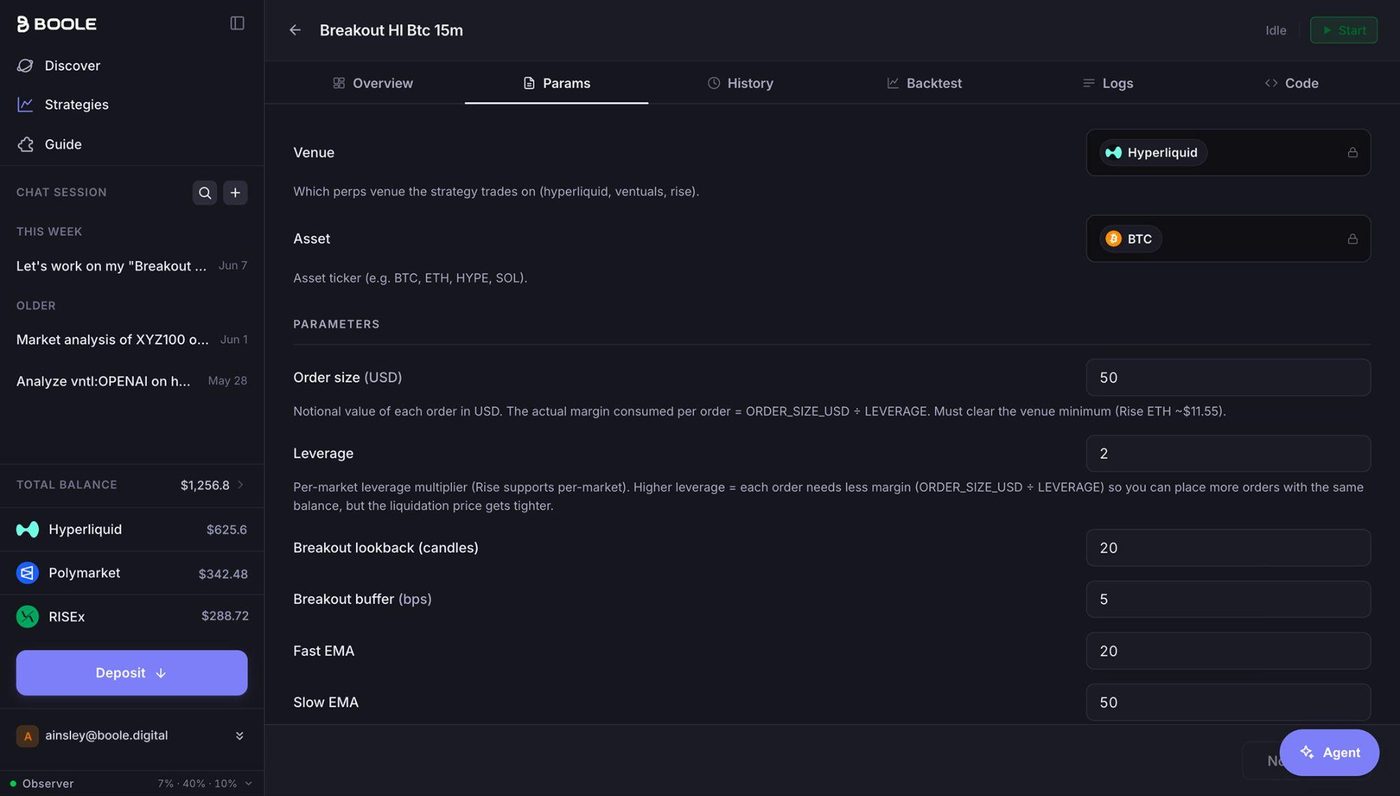
Every strategy operates within the guardrails you define, which include:
- Maximum drawdown limits
- Position sizing limits
- Exposure caps
- Kill switches
- Stop-loss and take-profit logic
- Trailing stops
These controls are enforced by the platform itself rather than relying on a language model to interpret instructions. If you are worried about visibility, stop-losses and take-profits can be managed privately within the system instead of being exposed on an exchange order book.
Most importantly, custody remains with you. Boole is non-custodial: it coordinates execution across venues, but your assets never leave your control.
Monitoring and signals
As the great Jim Simons once said, “There’s no such thing as the goose that lays the golden egg forever.” You must continually monitor your strategies, as they will experience alpha decay. Some experience this far faster than others, and in general long-term strategies like trend-following are not susceptible to it, for a myriad of reasons. Nevertheless, you must maintain and watch your strategies for metrics like:
- Price action
- Portfolio performance
- Correlations
- Delta exposure
- Multi-asset comparisons
Consult Boole to take action and help you maintain your strategy through the ever-evolving landscape of trading. Alerts can be delivered through Telegram for:
- Strategy triggers
- Price movements
- Polymarket events
- Portfolio activity
- Trader activity you follow
Custom trading interface
Every trader has a different way of seeing the market, so Boole lets you create the interface you want to trade on. You can build your own workspace around the data, strategies, alerts, charts, and actions that matter to you: a clean execution dashboard, a multi-strategy command center, or a more playful interface that turns trading into a lightweight game. Instead of forcing every trader into the same layout, Boole gives you the tools to shape the trading experience around how you think, monitor, and make decisions.
You describe a strategy, Boole gives it the same infrastructure a professional desk runs on, and it keeps going when you’re not at your screen. Test it on historical data first. Your funds never leave your wallet. If you’ve got a strategy you never had the time to run, run it here.
Try it out at trade.boole.markets.
Frequently asked questions
What is Boole?
Boole is an AI-powered trading desk for independent traders. You describe a strategy in plain English: the catalyst, entry and exit conditions, position sizing, and risk limits, and Boole turns it into an automated agent that backtests, executes across venues like Hyperliquid and Polymarket, and enforces your risk controls while your assets stay in your own custody.
How does Boole execute trades?
Once a strategy is defined, Boole runs it continuously across supported venues on a dedicated cloud server that is exclusively yours.
Is Boole custodial?
No. Boole is non-custodial. It coordinates execution across venues, but your assets never leave your control.
What venues does Boole support?
Boole supports Hyperliquid perpetual futures markets and Polymarket prediction markets, and can import and run TradingView strategies.
Do I need to know how to code to use Boole?
No. You define your strategy in plain English. If you can explain your strategy, you can run it. You can also import an existing TradingView strategy.