BlackRock and Visa Just Endorsed Circle. Morgan Stanley Says Sell It.
Eleven of the biggest names in finance signed on to validate Circle’s new chain the same week the stock sat 67% off its highs and Morgan Stanley cut its target to $38. One is pricing the business Circle is becoming. The other is repricing the one it still is.

One of the most impressive institutional endorsements in crypto history just landed on one of the ugliest charts on the NYSE. Arc is real, and Arc is not enough. Both halves of that sentence get tested inside the next two prints, and both can be true at $63.
The setup
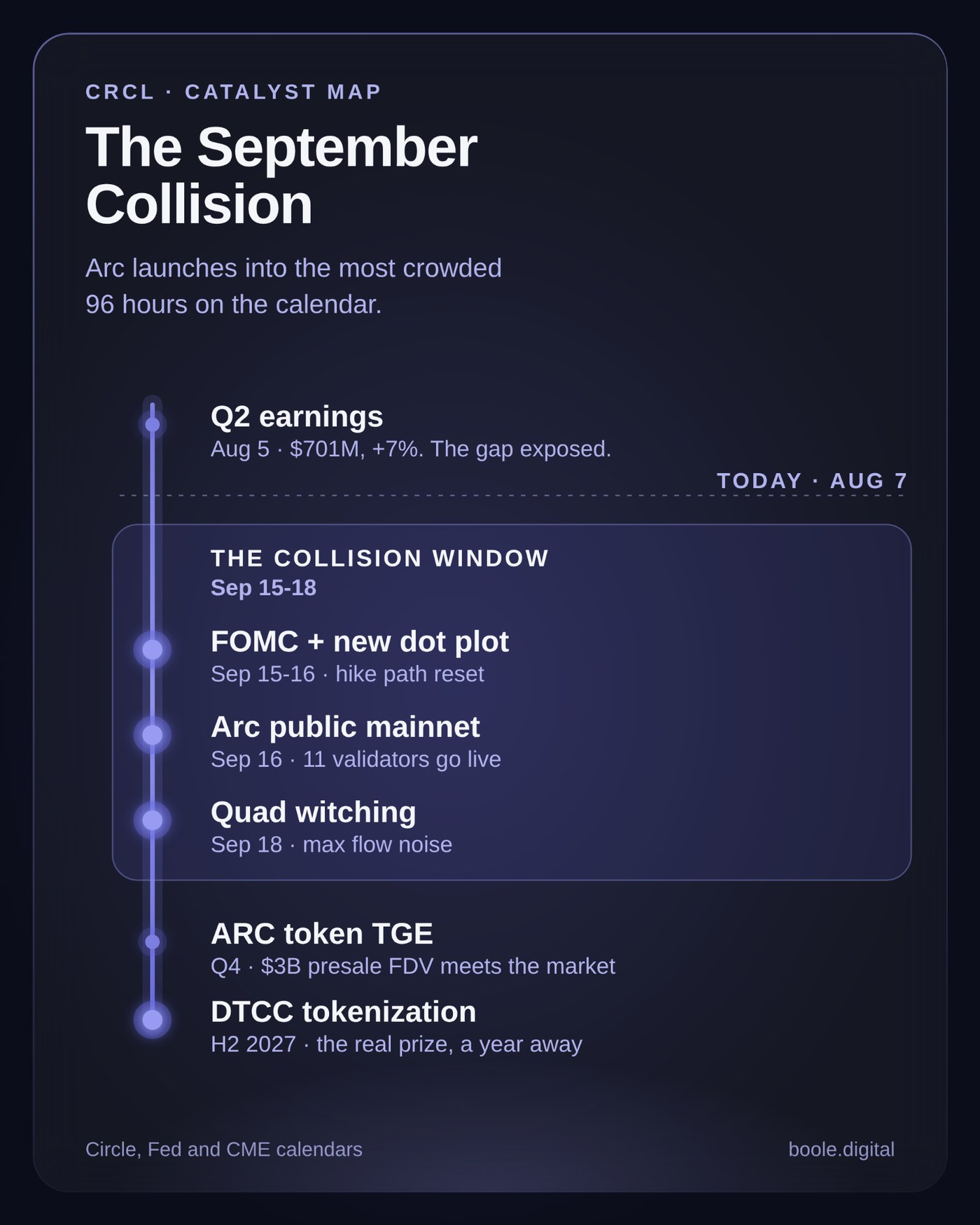
On September 16, Circle flips the switch on Arc, a purpose-built blockchain whose eleven founding validators read like the seating chart at Davos: BlackRock, DTCC, ICE, Visa, Mastercard and Standard Chartered among them. BlackRock is putting its BUIDL fund on the chain at launch. DTCC, the plumbing under the entire US securities market, has committed to tokenizing DTC-custodied assets on it. The token presale raised $222 million at a $3 billion valuation from a16z, BlackRock, and Apollo before a single block was produced.
If you drew up the bull case for institutional crypto adoption on a whiteboard, it would look exactly like this.
And yet: CRCL trades at $63, down 67% from its 52-week high, below every moving average that matters, four days removed from Morgan Stanley cutting its target from $106 to $38 and telling clients to sell.
One of the most impressive institutional endorsements in crypto history just landed on one of the ugliest charts on the NYSE. Here’s the walkthrough.
The number that broke the stock
Forget the downgrade headline for a second. The whole bear case fits in one line of Circle’s Q2 print, reported August 5:
- USDC in circulation: $73.3 billion, up 19% year over year
- On-chain transaction volume: $14.8 trillion, up 151%
- Revenue and reserve income: $701 million, up 7%
Read those in order. The float grew three times faster than revenue. Volume grew twenty times faster. Circle is winning the adoption war, with roughly 62% of stablecoin transaction volume on its rails, and monetizing less of it every quarter.
Now the part the headline growth rate hides. USDC closed Q1 at $77.0 billion, up 28% year over year, and closed Q2 at $73.3 billion, up 19%. The float did not just decelerate, it shrank by $3.7 billion quarter on quarter while the growth rate fell nine points in three months. That is the line the downgrade was built on, and the reason a 19% print did nothing for the stock.
Why does any of this crush revenue? Because Circle doesn’t really get paid for volume. It gets paid interest on the reserves backing USDC, and then hands a large and growing slice of that interest to distribution partners, Coinbase first among them. Both halves of that equation moved the wrong way this quarter: the reserve return rate fell to 3.5%, down 66 basis points year over year, which is why reserve income of $668 million grew only 5% on a float that grew 19%. Every new exchange, wallet, and bank that expands USDC’s reach also takes a bigger cut of what’s left. Usage compounds; economics don’t.
That’s the sentence behind the downgrade. James Faucette cut USDC supply forecasts by a third for 2027 and nearly half for 2028, putting EPS 20% below consensus two years out. Two supporting stats do the damage. Of $35 trillion in annual stablecoin volume, only about $390 billion, half of one percent, is identifiable real-world payments; the rest is trading churn that pays Circle almost nothing. And agentic payments, the future where AI agents transact autonomously in USDC, currently run about $41,900 a day at a 24-cent average ticket. The tech works. At that volume it is still a demo.
So why does BlackRock keep showing up?
Because a validator commitment is not a press-release partnership. It means putting infrastructure, legal review, and reputation on someone else’s chain, and DTCC tokenizing custodied assets on Arc is arguably the most consequential integration announced in crypto this cycle.
Arc also attacks Circle’s actual problem. The bear case, correctly, is that this is a rate-spread business, a money-market fund wearing a crypto costume, whose income gets crushed when the Fed cuts and whose distribution costs only ratchet up. Arc is the escape hatch: network infrastructure, fee revenue, gas paid in USDC, an “Economic OS” that earns money because volume happens rather than despite it. TD Cowen’s $82 Buy initiation is built on exactly this.
But hold the applause, because three details temper it for anyone trading this rather than tweeting it:
The timing is wrong for shareholders. DTCC’s tokenization starts H2 2027. The revenue that would re-rate this stock is more than a year past any tradable horizon.
The value may not accrue to CRCL. Arc has its own token, its own $3 billion valuation, and its own cap table. a16z, BlackRock and Apollo bought the token, not the stock. Watch what that did to the numbers: management doubled FY26 “other revenue” guidance to $310-330 million, and the filing says the raise “includes recognized ARC Token presale revenue.” A large slice of the apparent acceleration is proceeds from selling tokens, not recurring network economics. If ARC moons post-TGE while CRCL goes nowhere, the structure did exactly what it was built to do.
Everyone can see it coming. A launch date announced weeks ahead, a validator list pre-marketed to every desk on the street, a token event on the calendar: this is the textbook anatomy of a sell-the-news setup. The downgrade language itself (“weaker ex-Arc economics”) quietly concedes Arc works and argues the core rots underneath it anyway.
What would have to be true
Both cases are legible and, unusually for this sector, both are falsifiable. Here is what each side needs the next two prints to produce.
The following events would support the BlackRock and Visa thesis:
- Arc TVL made of real assets, not announcements. BUIDL is the tell, and the number that matters is the size BlackRock actually deploys in the first 90 days, not the fact that it deployed at all.
- Fee revenue in “other revenue” that is not token sales. Circle has already flagged that the FY26 guidance raise includes ARC presale proceeds. The Q4 print needs that line to grow with the presale stripped out.
- Payment volume, not trading volume. The damning stat in the downgrade is that half of one percent of stablecoin volume is identifiable payments. Moving that number is Arc’s entire purpose. If Q1 2027 activity still looks like exchange churn, the “Economic OS” was a slogan.
- USDC back above $77 billion, which reclaims the Q1 high and kills the contraction thesis outright.
The following events would support the Morgan Stanley thesis:
- A third consecutive quarter of float contraction. Below $70 billion and the contraction is structural.
- Reserve income still growing slower than the float, which means distribution partners are taking the incremental dollar and the margin story keeps degrading.
- Arc goes live and the only Arc revenue Circle books in Q4 is more token sales, confirming that network value accrues to the token rather than the equity.
- Agentic payments still measured in tens of thousands of dollars a day at the next print, when the bull case needs tens of millions.
One correction to the popular version of the bear case, because it changes what you watch. It does not require the Fed to cut. Higher-for-longer is a tailwind to reserve income on a $73 billion float, which is why September’s dot plot risk lands on the multiple and leaves the revenue line alone. What the bear case actually requires is that the float shrinks, which is a demand problem, not a rates problem. Anyone waiting on a dovish Fed to vindicate the $38 target is watching the wrong variable.
The two sides are not really arguing about whether Arc is impressive. They are arguing about whether the new business compounds faster than the old one decays. Every item above is a scoreboard entry on that question, and most of them print before the end of Q1 2027.
The tape and the levels
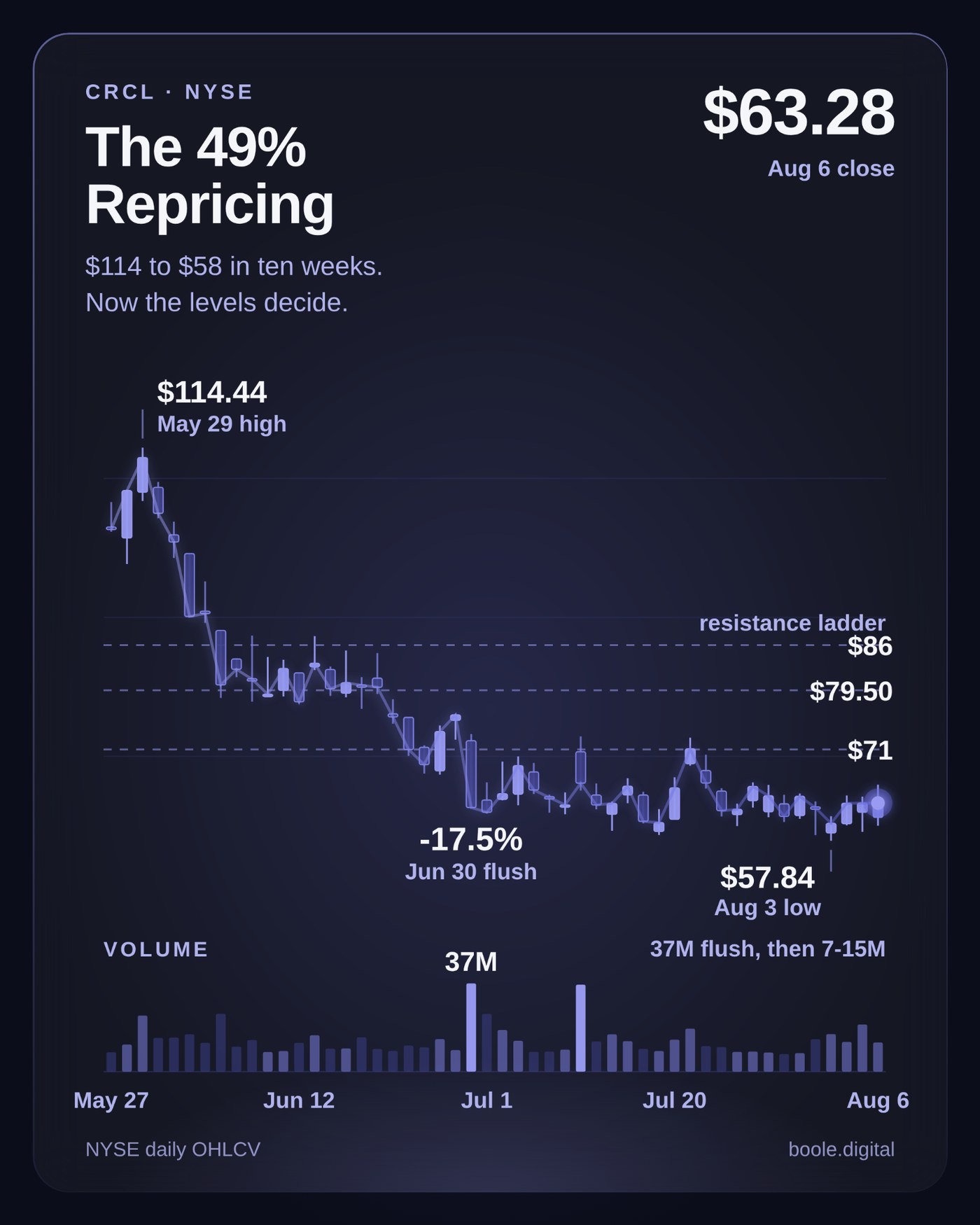
The chart is more interesting than the headlines. The August 3 flush to $57.84 refused to stay down: the stock reclaimed $63 through earnings, daily RSI recovered from sub-30 to 45 without a new price low, and ADX at 14 says the downtrend has lost its trend. That is seller exhaustion. It is not yet accumulation: the bounce is running 7-15M shares against the 37M capitulation days, price has retraced less than 10% of a 49% decline, and every moving average is overhead and falling. The market has finished panicking and hasn’t started believing.
It also isn’t cheap. Strip $1.73 billion of cash from the $16.1 billion market cap and CRCL trades at roughly 25 times annualized adjusted EBITDA, for a business whose core economics went backwards two quarters running. At $63, that is an Arc multiple.
Three levels carry the story from here:
- $57 has to hold. A daily close below says sellers were pausing, not finishing, and everything constructive here dies. Next stop is the 52-week low at $49.90.
- $71 settles the argument. The falling 50-day and the 0.236 retracement meet there. Reclaimed on 20M+ shares, the falling wedge confirms and $79.50 then $86 open up. Rejected on the same thin tape, and the bounce was short covering all along. Watch the volume on that day more than the price.
- $86.50 changes the regime. A weekly close above reclaims the 200-day and half the decline in one move. Below it, every rally is countertrend and rented.
The complication is the calendar. The Fed’s new dot plot lands September 15-16, the same window as the Arc launch, with quad witching on the 18th, in the weakest seasonal stretch of the year. A hawkish dot plot can gut the launch pop before it prints. Any strength into the event carries an expiry date.
The caveats that matter
Published targets run $38 to $82, a 2.2x spread. When dispersion is that wide nobody has a model, they have narratives, and price gets set by flow. Respect the volatility accordingly: realized vol is 77%, the average daily range is over 8% of the share price, and the whole distance from $63 to the $57 floor is one ordinary session. CRCL is also a maximum-beta crypto proxy, so any bitcoin flush or CLARITY Act headline marks the thesis to someone else’s liquidation.
Arc is real, and Arc is not enough.
The clean summary: both halves of that sentence get tested inside the next two prints, and both can be true at $63. Anything owned into September 16 is rented against a dated event. The thesis starts earning the benefit of the doubt only when Arc TVL, weekly USDC float, and actual fee revenue begin proving the endorsement was the point and not the peak.
Sources
- Circle: Founding validator cohort and integrations ahead of Sept 16 Arc mainnet
- StockTitan: Circle Q2 2026 results, $701M revenue, $73.3B USDC, guidance raise
- CoinDesk: Morgan Stanley downgrade, $38 target, USDC forecast cuts
- Benzinga: CRCL price targets range $38 to $82, bull and bear cases
- The Block: $222M ARC token presale at $3B FDV from a16z, BlackRock, Apollo
- StockAnalysis: CRCL quote, history, and analyst consensus
- Barchart: CRCL technicals, RSI, ADX, volatility
- CoinGape: Circle’s 62% share of stablecoin volume
- Circle: Q2 2026 results release, reserve return rate, adjusted EBITDA, validator cohort
- Circle: Q1 2026 results, USDC circulation of $77.0B at quarter end
This note is part of Boole’s desk research series. Not financial advice. Do your own research and size for the volatility this name actually has, not the volatility you’d like it to have.